
Whitewash: Whitewash is an old fashioned lime based paint – the French call it lait de chaux i.e. milk of chalk. It is also used metaphorically to describe ‘cover ups’ typically when politicians mount inquiries designed to hide the truth . This blog is about the material not the metaphorical meaning of whitewash.
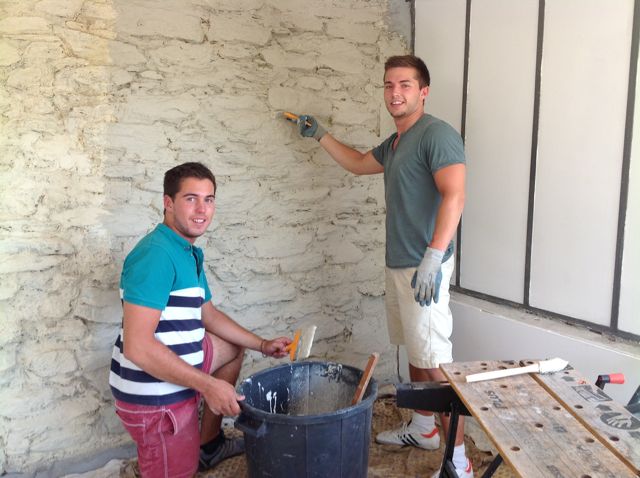
Whitewash has some remarkable virtues: it is cheap , effective at covering blemishes and filling crevices and it is breathable or permeable – any dampness in the underlying structure of the wall can evaporate without causing the paint to detach and flake off. This is why it is the only paint that can be used or frescos, if the artist wants the mural to survive. The virtues of whitewash were all good reasons to use it to cover the stone wall in our ancient garden cabin. The photo shows Jon & Mitch, our current workawayers , busily applying the first coat of whitewash in the cabin. Because whitewash is thick and creamy , it must be applied with large wide brushes which I remember my mother calling distemper brushes.
Distemper was what she called whitewash, a reference that confused me as a child because the same word meant the dreaded disease that our dog might catch. Distemper is actually a very ancient generic term for disease – it literally means to be out of temper with body fluids all out of whack. The same word emerged as a term for paint because distemper or whitewash is a based on solution of water and lime, in Latin distemper means to soak.
 Gardening in Provence