Blette or is it Bette


Enjoying blette a la Gloria

<img class=”alignright size-medium wp-image-124″ title=”Mick avec des blettes”

In Britain or the US, it is known as Swiss Chard, but in France the Swiss connection is absent, here it is simply called Blette or Bette. And Blette or French chard has its own distinctive look, Big, bold and bright green.

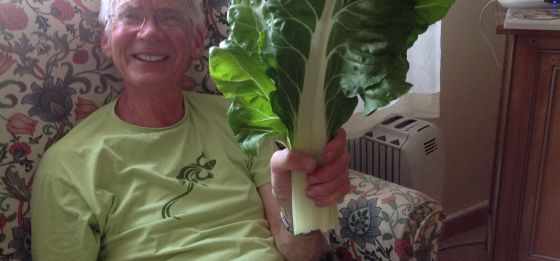
We grew some blette this year and it was a very productive crop. It is one of those cut and come again vegetables and we had 12 of them, enough to keep ourselves and our friends eating it as often as we liked. Here we have photo of Mick holding aloft a nice bunch of Blettes, it has been going now for 3 months and I believe there is more to come.

Chard, whether Swiss or French has never caught on in Britain. This may be why Elizabeth David, Britain’s ‘doyenne’ of French cuisine, has little regard for it, in her own words, ‘the large fleshy green leaves called blettes have not a great deal of flavour’, she recommends discarding the fleshy stalks, cooking the leaves like spinach and serving them in a creamy sauce. My dear Friend Gloria Schwartz gave me a much better recipe which capitalized on the fleshy stalks which have the most distinctive flavor. For this recipe you will need 6 large leaves of the kind Mick is displaying plus one egg, some seasoned breadcrumbs ( grind up the oldest chunk of bread in the bin and sprinkle with salt and pepper) and some light oil ( grape seed).
Wash the leaves, carve out the fleshy stalks and cut them into 2-3 inch lengths; chop the remaining leaves and set aside. Blanch the stalks for 3 minutes in boiling water, drain, pat dry and soak in the beaten egg, before coating them in the seasoned breadcrumbs . Heat the oil in a saute pan and when really hot, saute the crumand egg coated stalks until they look delicious, when all are cooked in this way, drain off the oi and drop the chopped leaves int the same pan adding a knob of butter. The leave will wilt quickly which is all you wnat them to do, add them to the cooked stalks in a serving dish and ( if you have it) grind a little nutmeg over the surface. Serve at once. Bon appetite

For other great recipes using Blettes – try Otto Lenghi’s cookbooks.

Whitewash

Whitewash: Whitewash is an old fashioned lime based paint – the French call it lait de chaux i.e. milk of chalk. It is also used metaphorically to describe ‘cover ups’ typically when politicians mount inquiries designed to hide the truth . This blog is about the material not the metaphorical meaning of whitewash.

Whitewash has some remarkable virtues: it is cheap , effective at covering blemishes and filling crevices and it is breathable or permeable – any dampness in the underlying structure of the wall can evaporate without causing the paint to detach and flake off. This is why it is the only paint that can be used or frescos, if the artist wants the mural to survive. The virtues of whitewash were all good reasons to use it to cover the stone wall in our ancient garden cabin. The photo shows Jon & Mitch, our current workawayers , busily applying the first coat of whitewash in the cabin. Because whitewash is thick and creamy , it must be applied with large wide brushes which I remember my mother calling distemper brushes.

Distemper was what she called whitewash, a reference that confused me as a child because the same word meant the dreaded disease that our dog might catch. Distemper is actually a very ancient generic term for disease – it literally means to be out of temper with body fluids all out of whack. The same word emerged as a term for paint because distemper or whitewash is a based on solution of water and lime, in Latin distemper means to soak.

Wow Wisconsin

Deb


In the fall and winter of 2011/12 we had an exchange programme with the state of Wisconsin. It was the brain child of our resident house sitter, Deb Biechler who persuaded her friends to come visit her in Bormes and while they were with her, she put them all to useful employment. We are left with the impression of Wisconsin as the home of super practical professionals – ‘hell raising ‘ men & women who, when not in the office, casually clear virgin forest, fell trees, erect fences, build stone walls, repair woodwork just like that Hollywood vision of Oklahoma which older readers will remember in their childhood. They left a lasting legacy at L’Orangerie, the question is: Can we persuade the Deb and her Dream Team to come back again?

Heritage Tomatoes July 24th 2012

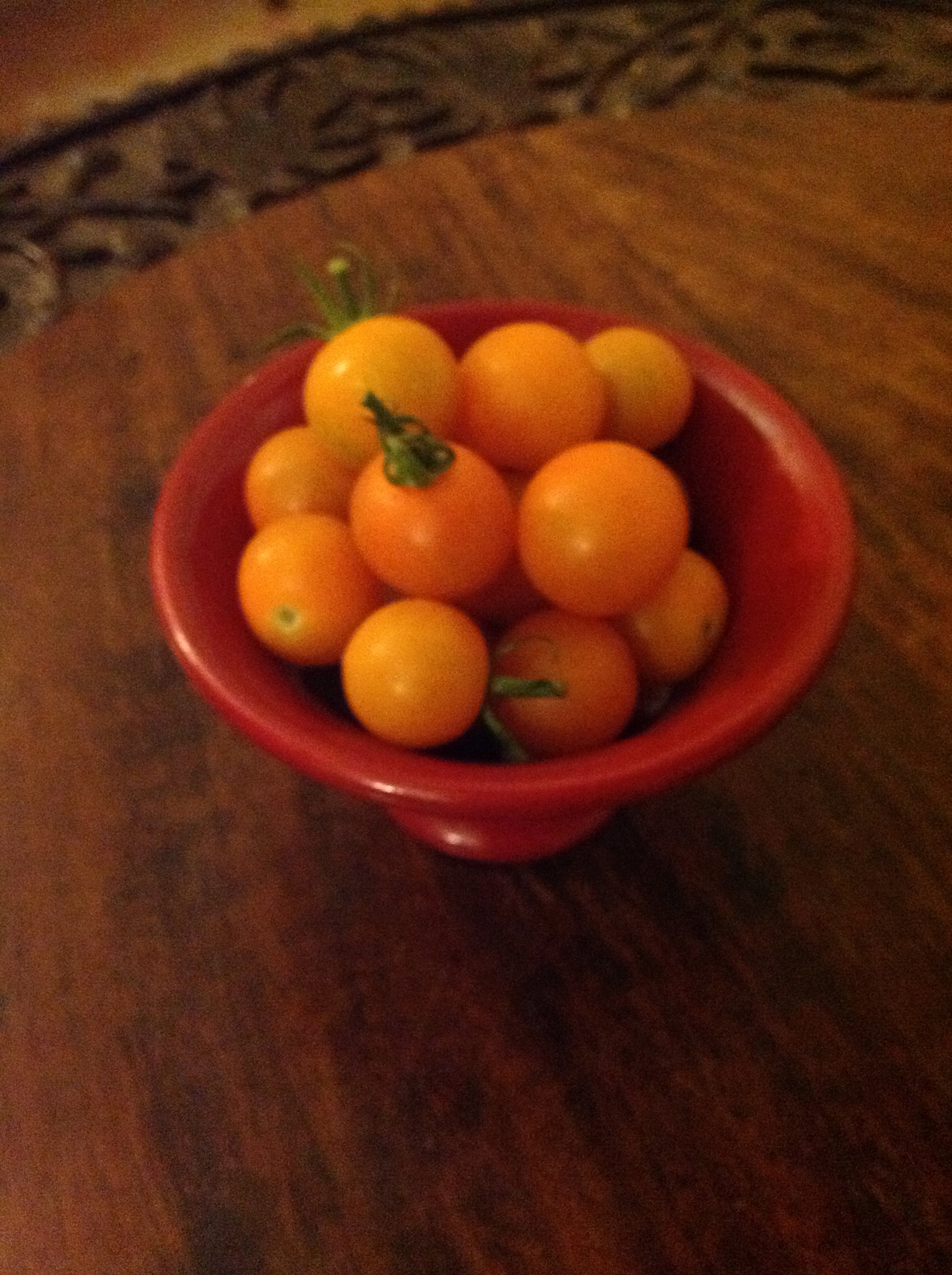
Golden lemon tomatoes freshly harvested.

The first tomatoes to reach Europe arrived in the 16th century. Though they made their maiden voyage on Spanish vessels, it was the Italians who embraced them with greatest enthusiasm . They named tem pomodoro or golden apples indicating that the first exotic imports were yellow and not red. Nevertheless, it was the red tomato that was destined to become the emblematic legume of modern i.e. post Columbian Italian cuisine, the principal ingredient which even today makes the food of food the most versatile and readily available vegetarian option. Not that it was spurned by meat eating Americans who bathe their hamburgers and fries in tomato ketchup. The tomato is a member of the same family (Solanaceae) as the potato, the pepper, the aubergine (egg plant). Like these vegetables, when it first arrived it bore little relationship to the bland industrial age vegetables which are piled high on every supermarket veggie stall. When these highly nutritious vegetables first arrived, they entered what might be called a love/hate relationship with Europeans. Many viewed them as poisonous because they belong to the same family as Belladonna – the Deadly Nightshade while others thought the tomato was a pomme d’amour having aphrodisiac properties.

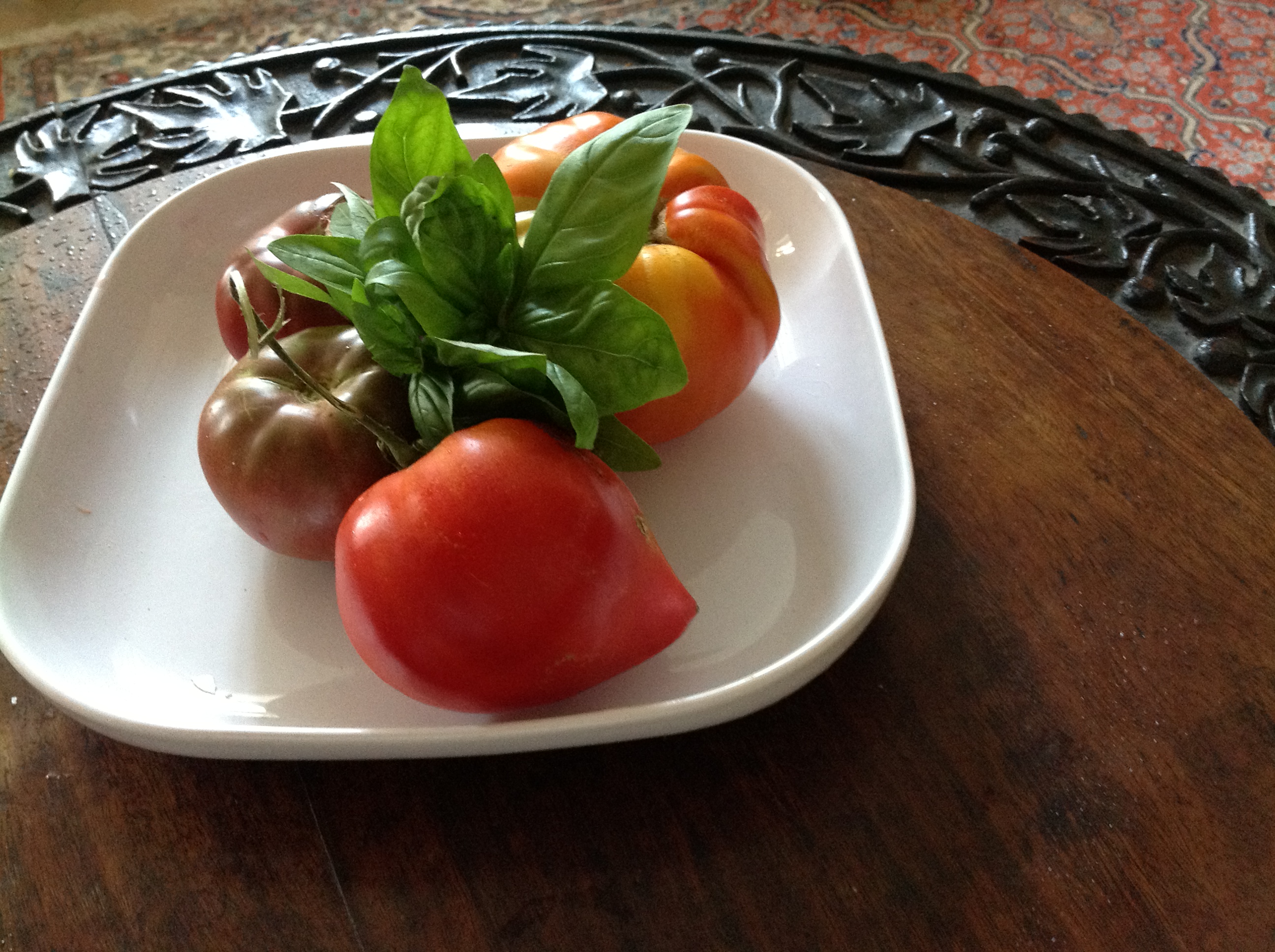
Today, the tomato is the centerpiece of efforts to recapture the ‘natural’ goodness of food in the form of heritage crops and with good reason. The heritage tomato is truly delicious, on its own straight from the vine or steeped in a bath of lemon infused olive oil seasoned lightly with salt and black pepper. Our heritage tomatoes have been ready to eat since mid July. We eat them the same day we pick them, usually one or two at a time either as a salad to accompany the midday or evening meal or as a sensational appetizer as follows:

Heritage Tomato Bruschetta

Ingredients:

1. Fresh tomatoes preferably heritage but nice smelling supermarket varieties also taste good prepared this way;
2. Fresh artisan bread lightly toasted in bite sized pieces,
3. Olive oil plain or infused with lemon, basil or thyme;
4. Chopped fresh basil or coriander ( cilantro) – optional.
5. Salt and pepper to taste ( if you use a salt grinder, try adding fennel seed to the salt for a delicious special effect).

Prepare the tomatoes by deseeding and chopping, I also remove any tiny fibrous green stalky bits;
Soak them in the olive oil ( don’t be stingy, if you overdo it, keep the tomato scented oil and use to flavor a baked fish or vegetable dish);
Add the chopped herbs if using;
After and interval ( 5 minutes to 5 hours), pile the chopped tomatoes on the toast and drizzle the oil over them so as to let it soak into the bread.

.

Emah’s Birthday

Today was Emah’s birthday. She is third from the left holding a bunch of Lavender and wearing a big happy smile.  Maybe that is something to do with  with the scrumptious coffee meringue cake which she is about to slice into.  Emah and Jill ( sitting on her right)  hail from  Vancouver, Canada, they are in the of midst  of  a round the world journey. We feel very privileged that they stopped off here for a few weeks .    In this photo, Janet and  Alex  are also holding lavender posies  while little Amelie gives the thumbs up sign.  She is really waiting for someone to cut the ice cream cake.  Giles, her father, is smiling benignly at either the cake or his daughter.  He tells us that he does not normally tuck into treats  like this but he is making an exception because  the cake has come from La Sirene, where, as he points out, they know how to make a cake to perfection.  To celebrate the birthday, we sat around the table in the shadiest part of the garden, Baloo’s favorite spot,  and marveled at the skill of the local patisserier La Sirene.   Emah & Jill are working and winding their way around the world.  Though they look petite and slender,  don’t be fooled they can lift heavy loads and are ready to get stuck into whatever needs doing.  Whether it is evacuating building  rubble   or  helping icky create her much awaited blog!

The importance of garden paths

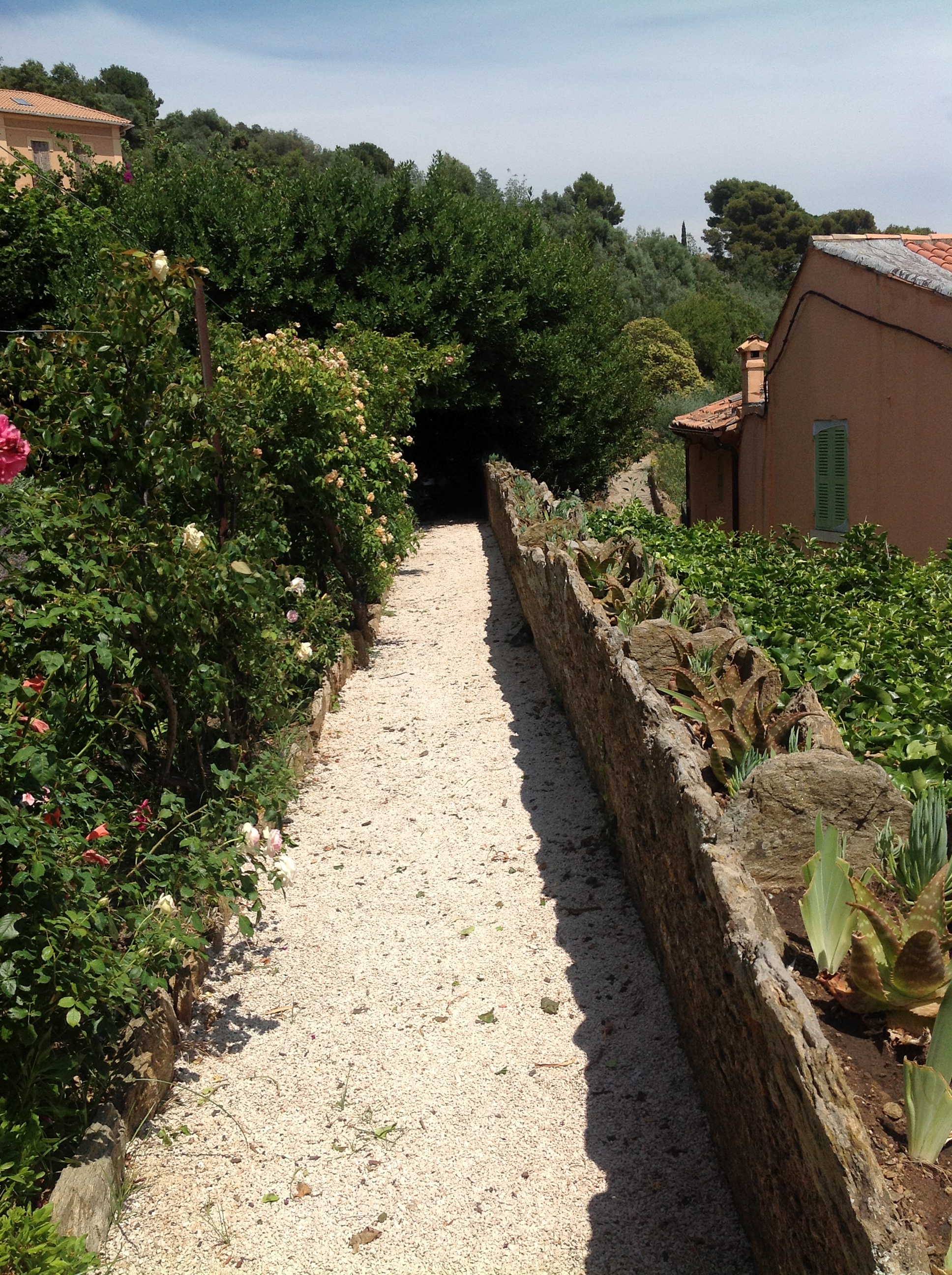
When we acquired L’Orangerie in 2007,   the garden resembled a mediterranean jungle.   The system of  garden walkways which must have once provided an enchanting evening stroll for guests of the Grand Hotel had all but disappeared, and the few  that remained  were unpaved  and periodically smothered with weeds. As we surveyed our beautiful exotic wilderness, it was obvious that the first act of restoration must be the re-installation of a system of pathways which would divide the main part garden into different zones providing a means of communication/ supply and eventually the route for an early morning or evening perambulation.  Take a look at some of the pathways we created.