

Enjoying blette a la Gloria
<img class=”alignright size-medium wp-image-124″ title=”Mick avec des blettes”
In Britain or the US, it is known as Swiss Chard, but in France the Swiss connection is absent, here it is simply called Blette or Bette. And Blette or French chard has its own distinctive look, Big, bold and bright green.
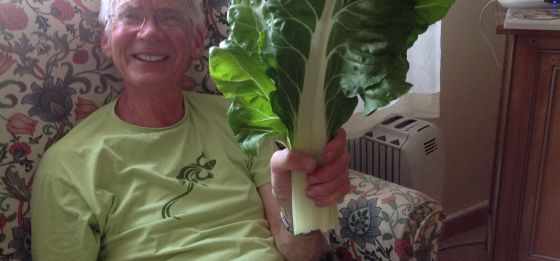
We grew some blette this year and it was a very productive crop. It is one of those cut and come again vegetables and we had 12 of them, enough to keep ourselves and our friends eating it as often as we liked. Here we have photo of Mick holding aloft a nice bunch of Blettes, it has been going now for 3 months and I believe there is more to come.
Chard, whether Swiss or French has never caught on in Britain. This may be why Elizabeth David, Britain’s ‘doyenne’ of French cuisine, has little regard for it, in her own words, ‘the large fleshy green leaves called blettes have not a great deal of flavour’, she recommends discarding the fleshy stalks, cooking the leaves like spinach and serving them in a creamy sauce. My dear Friend Gloria Schwartz gave me a much better recipe which capitalized on the fleshy stalks which have the most distinctive flavor. For this recipe you will need 6 large leaves of the kind Mick is displaying plus one egg, some seasoned breadcrumbs ( grind up the oldest chunk of bread in the bin and sprinkle with salt and pepper) and some light oil ( grape seed).
Wash the leaves, carve out the fleshy stalks and cut them into 2-3 inch lengths; chop the remaining leaves and set aside. Blanch the stalks for 3 minutes in boiling water, drain, pat dry and soak in the beaten egg, before coating them in the seasoned breadcrumbs . Heat the oil in a saute pan and when really hot, saute the crumand egg coated stalks until they look delicious, when all are cooked in this way, drain off the oi and drop the chopped leaves int the same pan adding a knob of butter. The leave will wilt quickly which is all you wnat them to do, add them to the cooked stalks in a serving dish and ( if you have it) grind a little nutmeg over the surface. Serve at once. Bon appetite
For other great recipes using Blettes – try Otto Lenghi’s cookbooks.
 Gardening in Provence
